

Note
Go to the end to download the full example code.
BRDFs in Action#
Plotting BRDF kernels and their rendered results
import matplotlib.pyplot as plt
import numpy as np
import pyvista as pv
from PIL import Image

import mirage as mr
import mirage.vis as mrv

brdfs = [
    # mr.Brdf('diffuse', 0.5, 0.0, 0),
    # mr.Brdf('oren-nayar', 0.5, 0.0, 0),
    # mr.Brdf('phong', 0.5, 0.5, 5),
    mr.Brdf('blinn-phong', 0.0, 0.5, 5),
    # mr.Brdf('ashikhmin-shirley', 0.5, 0.5, 15),
    mr.Brdf('cook-torrance', 0.0, 0.5, 0.3),
    # mr.Brdf('glossy', 0.5, 0.5, 0.9),
]

num = 200
pl_shape = (3, 3)
arrow_scale = 0.5
el_space, az_space = np.linspace(0.1, np.pi / 2, num), np.linspace(0, 2 * np.pi, num)
el_grid, az_grid = np.meshgrid(el_space, az_space)
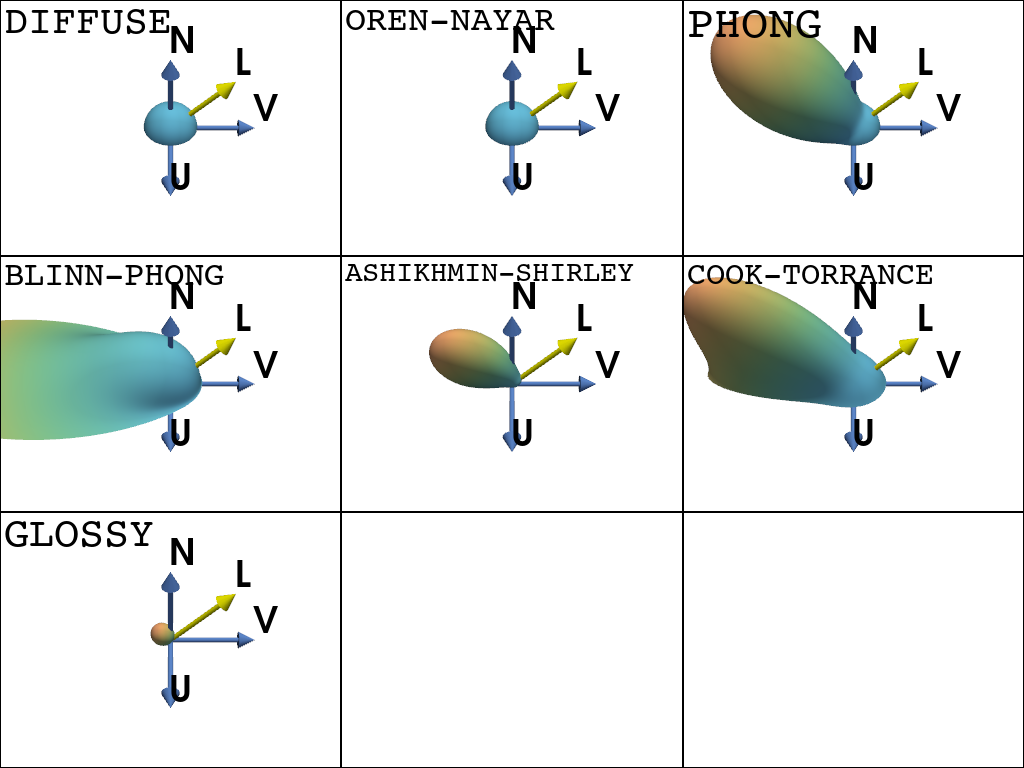
Now we can iterate through a range of specular exponents and BRDFs to visualize how the BRDF varies
pl = pv.Plotter(shape=pl_shape)
pl.set_background('white')
for i, brdf in enumerate(brdfs):
    (xx, yy, zz) = mr.sph_to_cart(az_grid, el_grid, 0 * el_grid + 1)
    O = np.hstack(
        (
            xx.reshape(((num**2, 1))),
            yy.reshape(((num**2, 1))),
            zz.reshape(((num**2, 1))),
        )
    )
    L = mr.hat(np.tile(np.array([[0, 1, 1]]), (num**2, 1)))
    N = mr.hat(np.tile(np.array([[0, 0, 1]]), (num**2, 1)))
    b = brdf.eval(L, O, N).reshape(xx.shape)
    mesh = pv.StructuredGrid(xx * b, yy * b, zz * b)
    pl.subplot(i // 3, i % 3)
    pl.add_text(f'{brdf.name.upper()}', font_size=18, font='courier', color='black')
    pl.add_mesh(
        mesh,
        scalars=b.T.flatten(),
        show_scalar_bar=False,
        cmap='isolum',
        smooth_shading=True,
    )
    mrv.plot_basis(
        pl, np.eye(3), color='cornflowerblue', labels=['U', 'V', 'N'], scale=arrow_scale
    )
    mrv.plot_arrow(
        pl,
        origin=[0, 0, 0],
        direction=L[0, :],
        scale=arrow_scale,
        color='yellow',
        label='L',
    )

pl.link_views()
pl.camera.position = (2.0, 0.0, 2.0)
pl.camera.focal_point = (0.0, 0.0, 0.0)
pl.show()
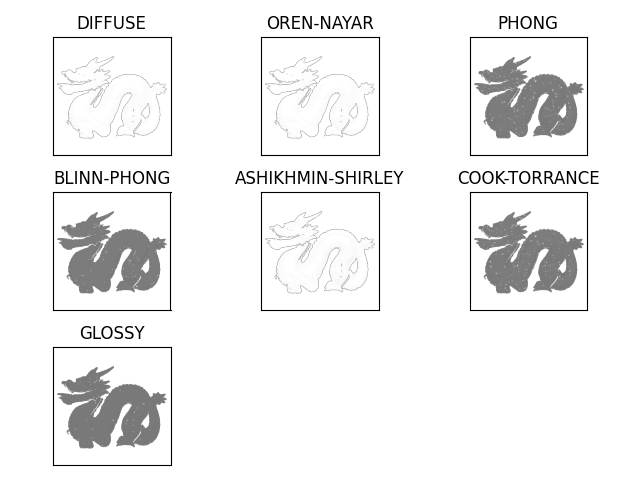
Plotting rendered result with the same BRDFs
ovb = mr.hat(np.tile(np.array([[-1.0, 0.0, 0.5]]), (1, 1)))
svb = mr.hat(np.tile(np.array([[-0.5, 0.0, 0.5]]), (1, 1)))

for i, brdf in enumerate(brdfs):
    mr.run_light_curve_engine(
        brdf, 'stanford_dragon.obj', svb, ovb, save_imgs=True, instances=1
    )
    plt.subplot(*pl_shape, i + 1)
    im = np.asarray(Image.open('out/frame1.png'))
    plt.imshow(im[:, :, 0], cmap='gray', alpha=(im[:, :, 1] > 0).astype(np.float32))
    plt.xticks([])
    plt.yticks([])
    plt.title(brdf.name.upper())
plt.tight_layout()
plt.show()
Model file stanford_dragon.obj not found in current model folder ('/home/liam/Documents/mirage/mirage/resources/models'), checking model repository...
Attempting to download stanford_dragon.obj and its associated material file from the model repository...
Requesting: https://raw.githubusercontent.com/ljrobins/mirage-models/refs/heads/main//Non-Convex/stanford_dragon.obj
Requesting: https://raw.githubusercontent.com/ljrobins/mirage-models/refs/heads/main//Non-Convex/stanford_dragon.mtl
Model files were downloaded successfully!
Total running time of the script: (0 minutes 6.913 seconds)